Proactively exploit resource-leveling intellectual capital through user friendly imperatives. Phosfluorescently actualize technically sound platforms with clicks-and-mortar benefits. Dramatically procrastinate economically sound architectures rather than future-proof.
Advancing operational resilience through rigorous confined space oversight and systematic risk mitigation
Confined spaces represent some of the most perilous working environments across both general industry and construction sectors. Hazards within these spaces are often invisible, ranging from toxic atmospheric conditions to sudden physical engulfment. Because a flawed entry attempt can lead to catastrophic, multi-fatality incidents—frequently involving unprotected rescue personnel—establishing a rigid, legally compliant framework is a critical operational necessity.
Statutory Identification & Flowchart Logic
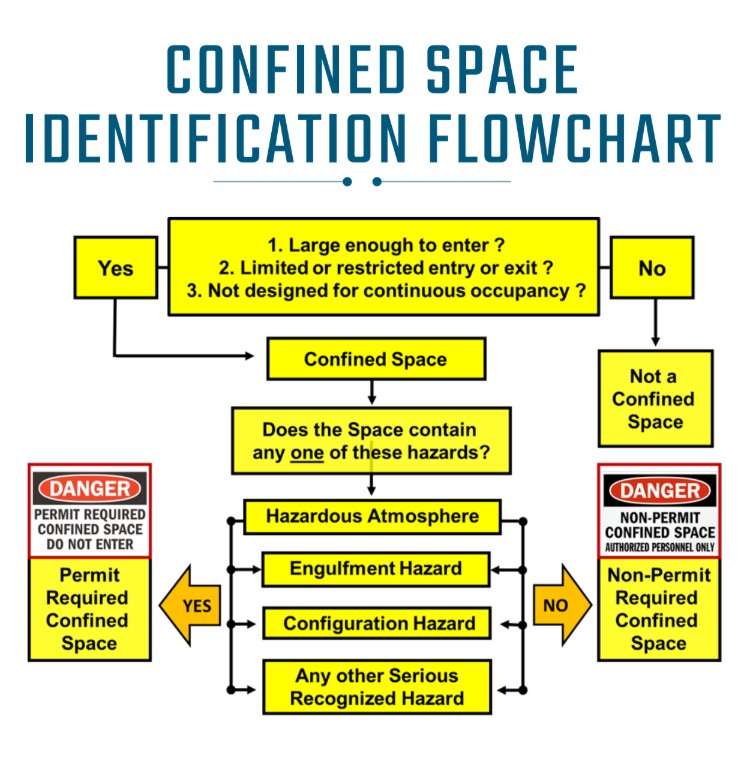
Federal safety compliance is strictly mandated under two primary standards: 29 CFR 1910.146 for General Industry and 29 CFR 1926 Subpart AA for Construction. To navigate these risk, employers need to evaluate whether a work area is a Confined Space based on three concurrent criteria:
Bodily Entry: It is large enough and configured so that an employee can bodily enter it and perform assigned work.
Limited Entry/Exit: It has limited or restricted means for entry or exit (e.g., tanks, vessels, silos, storage bins, hoppers, vaults, and pits).
Not Designed for Continuous Occupancy: It is not explicitly designed for ongoing human habitation.
Per OSHA regulations, if a space meets these parameters, employers must further assess whether it requires an active entry permit. A space is classified as a Permit-Required Confined Space (PRCS) if it exhibits one or more of the following serious hazards:
Contains or has the potential to contain a hazardous atmosphere.
Contains a material that has the potential for engulfing an entrant.
Has an internal configuration with inwardly converging walls or a downward-sloping floor that tapers to a smaller cross-section, creating an asphyxiation or entrapment risk.
Contains any other recognized serious safety or health hazard (e.g., exposed live machinery, chemical exposure, or extreme temperatures).
If the space exhibits none of these characteristics, it is classified as a Non-Permit Required Confined Space.
Core Pillars of a Confined Space Program
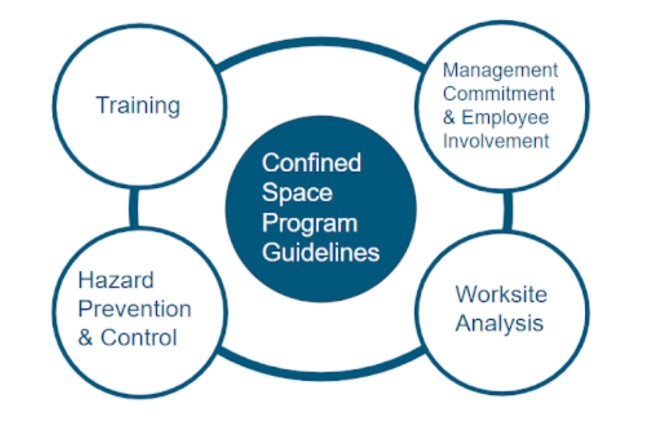
Maintaining compliance and protecting workers requires an integrated organizational framework rather than isolated pieces of field equipment. A comprehensive written safety program must explicitly integrate four core management pillars:
Worksite Analysis: Systematically surveying the facility to identify, catalog, and clearly label all confined spaces with highly visible danger signs.
Hazard Prevention and Control: Implementing engineering controls (such as purging, continuous forced-air ventilation, or complete Lockout/Tagout isolation) to mitigate risk before anyone crosses the threshold.
Management Commitment and Employee Involvement: Driving a culture of shared vigilance where leadership provides calibrated safety equipment and workers actively participate in regular program reviews.
Comprehensive Training: Providing rigorous, role-specific education so that employees understand the precise hazards they face and the proper use of protective equipment.
Pinnacol Assurance's Confined Space Training
An engineering control or entry permit system is only as reliable as the personnel executing it. To support your workforce compliance and safety culture, Pinnacol Assurance offers specialized Confined Space Training course designed to answer a critical operational questions.
This technical class is designed to provide safety managers, supervisors, and field staff with the precise information needed to look for and determine whether a confined space is dangerous. The curriculum focuses on:
Hazard Identification: Training employees to detect visible and hidden health or safety threats before entering a space.
Space Classification: Mastering the structural and atmospheric criteria used to identify and classify different types of confined spaces.
Regulated Safety Roles: Clearly delineating and discussing the strict regulatory responsibilities and boundaries of the confined space entrant, attendant, and supervisor.
Need One-on-One Guidance?
Your dedicated safety consultant is here to help. Reach out today for personalized support with OSHA compliance, ergonomic guidance, and comprehensive risk assessments tailored specifically to your workplace.